
Last updated October 16, 2026
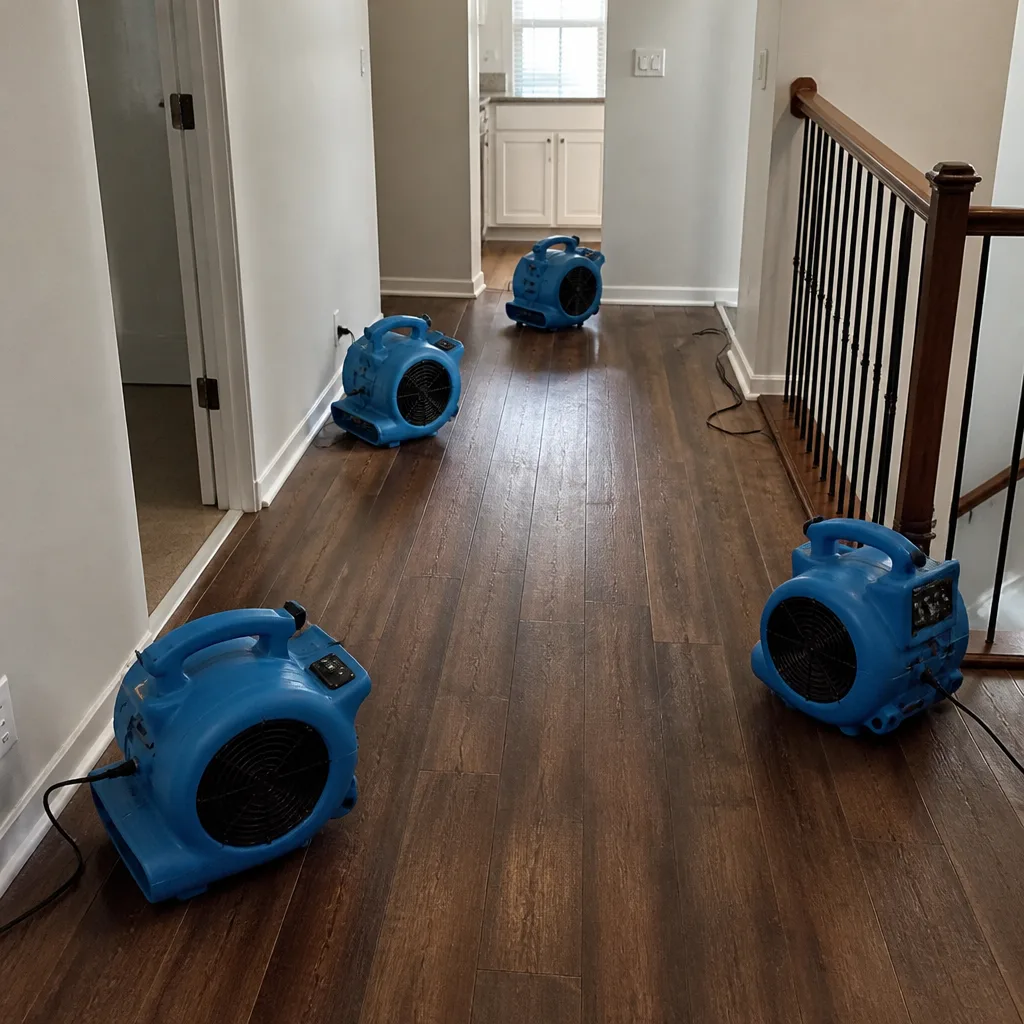 Water damage drying
 Fire & smoke cleanup
 Mold remediation
 Storm response
 Sewage cleanup
 Reconstruction
Free visual inspection and a written scope of work before any mitigation begins - photos, moisture readings, and drying logs go in your claim file
The scope we write is the scope we bill. Anything new gets shown to you, in writing, before we touch it.
Get your free estimateThe Complete Guide to Damage Restoration in Brooklyn
A Park Slope brownstone and a new Williamsburg condo can sit three blocks apart and require completely different restoration approaches after the same storm, yet most guides treat every house the same. Brooklyn is not a generic housing market. It is a patchwork of 19th-century brick, mid-century six-story walk-ups, converted lofts, and basement apartments carved out of foundations decades before anyone thought about waterproofing. This guide explains how water, fire, and mold damage actually behave in Brooklyn’s specific building types, what restoration costs in this borough’s labor market, and how to read an estimate so you are not comparing apples to advertising. You will leave with a working understanding of the restoration sequence, the permit layers most national guides skip, and the questions to ask before anyone touches a tool.
Restoration work we handle
Quick Answer
Damage restoration in Brooklyn typically costs $2,800 to $11,000 for water mitigation and rebuild, $4,500 to $28,000 for mold remediation depending on square footage and cavity spread, and $7,500 to $45,000+ for fire damage that includes smoke sealing and structural repair. The single most important decision is the order of operations: mitigation first (stop the water, heat, or mold growth), then demolition, then structural repair, then finishing. In Brooklyn specifically, age of building, landmark district status, and clay sewer lateral condition change both the timeline and the price. Dryden Restoration Brooklyn home guides this entire article with Brooklyn-specific detail.
Table of Contents
- Why Brooklyn’s Building Stock Changes Everything
- Water Damage in Brooklyn: How It Starts, Spreads, and Gets Fixed
- Mold Remediation in Brooklyn: The Humidity Problem
- Fire Damage in Brooklyn: Soot, Smoke, and the Second Fire Nobody Talks About
- How to Read a Restoration Estimate Line by Line
- The Sequence of Trades: Why Order Matters More Than Speed
- Landmarked Districts, DOB Permits, and the Brooklyn Paperwork Layer
- Clay Sewer Laterals and the Combined Storm-Sewer System: Brooklyn’s Hidden Water Problem
- Common Mistakes to Avoid
- When to Call a Professional
- Frequently Asked Questions
- The Bottom Line
Why Brooklyn’s Building Stock Changes Everything
Brooklyn has roughly 1 million housing units, and a significant portion of them were built before 1930. That means brick load-bearing walls, wood joists that have been drying for a century, and basements that were never designed to be living space. When water enters a pre-war brownstone, it does not just wet the drywall. It soaks into plaster, travels along joist pockets, and wicks up through brick that acts like a sponge. A water event that would take three days to dry in a suburban home with modern framing can take six to eight days in a Carroll Gardens brownstone, simply because the materials hold moisture longer and the wall cavities are not ventilated the same way.
Newer construction in Williamsburg, Downtown Brooklyn, and the waterfront areas presents a different challenge: high-density buildings with shared walls, modern drywall, and mechanical systems packed into tight chases. Water travels vertically through pipe chases faster than it travels horizontally across a floor. We have seen a fifth-floor supply line leak in a Williamsburg condo present as water damage in a second-floor bathroom three days later, because the water followed the pipe chase down through the building. Restoration in newer buildings is less about drying old materials and more about tracing hidden paths through shared cavities.
Basement apartments deserve their own paragraph. Brooklyn has tens of thousands of below-grade living spaces, many of them legal but many not. These spaces sit below the water table in some neighborhoods, particularly in low-lying areas like Gowanus, Red Hook, and parts of southern Brooklyn. A basement apartment in these areas can flood from groundwater intrusion even without a storm, simply because the water table rises after heavy rain and the foundation was never waterproofed. Restoration in below-grade spaces requires addressing the water source first, not just the water that has already entered.
Water Damage in Brooklyn: How It Starts, Spreads, and Gets Fixed
Water Damage Restoration in Brooklyn begins the same way everywhere: stop the source, extract the standing water, dry the structure, and repair what was damaged. The difference in Brooklyn is the source. In our experience, the most common sources are burst supply lines in older galvanized or copper piping, failed water heater tanks, apartment-to-apartment leaks from the unit above, and basement seepage through foundation walls. Each source requires a different response.
A burst supply line is the most urgent. Water under street pressure can dump 6 to 12 gallons per minute. In the 20 minutes it takes a homeowner to find the shutoff valve, 120 to 240 gallons have entered the space. By the time we arrive, the water has typically traveled through the floor assembly into the ceiling below, which means the restoration scope includes the unit below as well. This is a Brooklyn reality that national guides do not address: most water damage in Brooklyn multi-family buildings involves at least two units, and sometimes three or four.
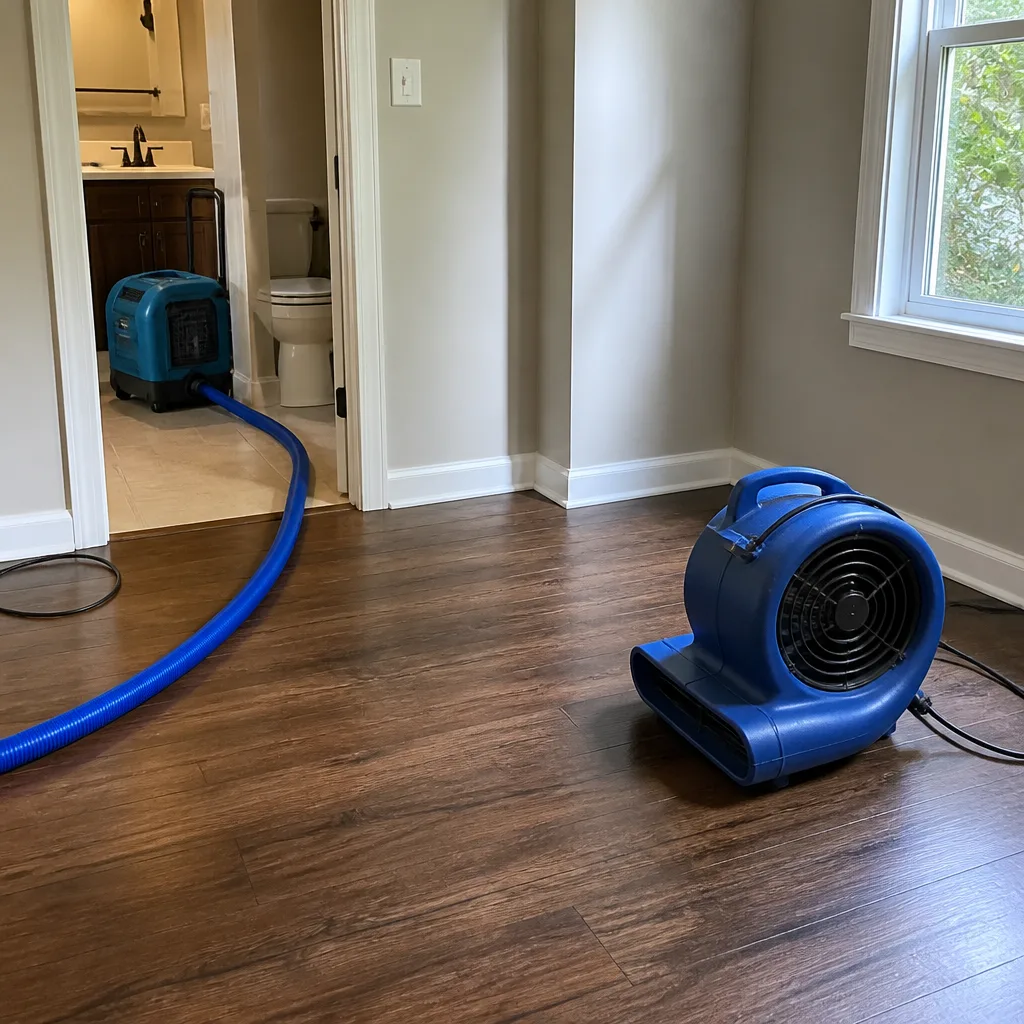
The drying process for water damage follows a specific sequence. First, extraction removes standing water using submersible pumps and truck-mounted or portable extraction units. Then we set up air movers and dehumidifiers to create what the industry calls psychrometric drying, which is the science of controlling temperature, humidity, and airflow to dry materials at the right rate. Dry too fast and wood splits and plaster cracks. Dry too slow and mold takes hold, typically within 48 to 72 hours in Brooklyn’s summer humidity. Equipment brands matter here: we run Dri-Eaz and Phoenix dehumidifiers and air movers, the same machines large commercial restoration crews use, because they move more air and pull more moisture per kilowatt-hour than consumer-grade equipment.
Time to dry in a Brooklyn rowhouse averages four to seven days. In a basement apartment with masonry walls, it can stretch to ten days or more, because the brick and concrete hold moisture long after the air is dry. We use moisture meters to track progress in the materials themselves, not just the room air, and we do not remove equipment until the numbers say the structure is dry.
Cost ranges for water damage restoration in Brooklyn run from $2,800 on the low end for a contained bathroom leak with no cabinet or flooring replacement, to $8,000 to $11,000 for a multi-room supply line break that requires floor removal, drywall replacement, and full drying. These are Brooklyn labor and material prices, not national averages. National averages are typically 20% to 30% lower than what Brooklyn’s union labor, older building complexities, and permit fees actually cost.
Mold Remediation in Brooklyn: The Humidity Problem
Brooklyn summers are humid. July and August average relative humidity (RH) above 70%, and interior RH in older buildings without central air conditioning routinely sits above 60%, which is the threshold at which mold begins to grow on organic materials. Mold Remediation in Brooklyn is therefore not a rare specialty; it is a routine part of living in this borough’s housing stock.
Mold growth after water damage begins within 48 to 72 hours if the materials stay wet. The most common places we find mold in Brooklyn homes are behind basement drywall that was installed directly against foundation walls, in crawl spaces under pre-war frame houses in neighborhoods like Marine Park and Mill Basin, in bathroom ceiling cavities below upstairs plumbing, and in closet walls that share a cavity with an exterior masonry wall. The pattern is consistent: moisture gets trapped in a low-airflow cavity, condensation forms, and mold follows.
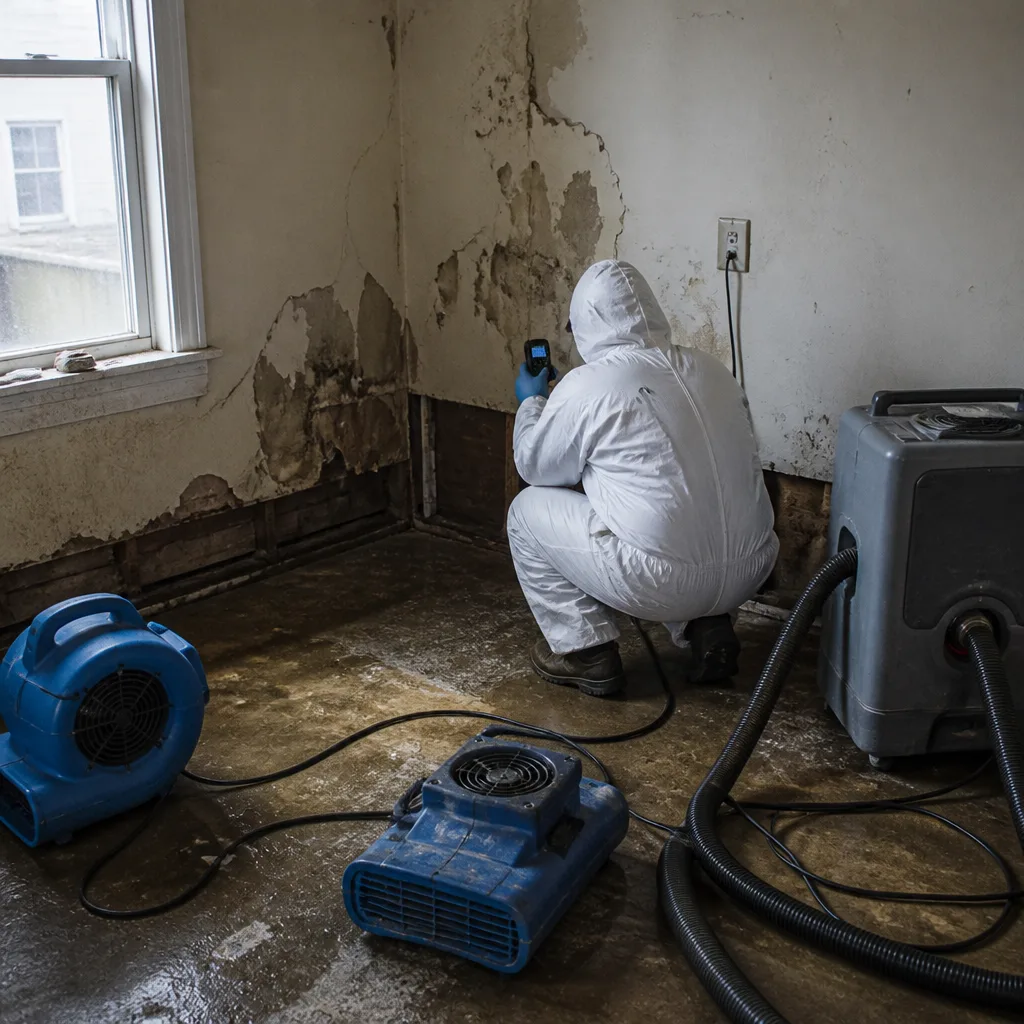
Remediation is more than spraying bleach. Bleach kills surface mold but does not address the roots, or hyphae, that penetrate porous materials like drywall, plaster, and wood. Proper remediation requires removing affected porous materials, cleaning non-porous surfaces with antimicrobial agents, and then drying the cavity to below 50% RH. For small isolated areas (under 10 square feet), a homeowner can sometimes handle it with proper PPE. For anything larger, or any mold that has entered wall cavities or the HVAC system, a professional remediation is the safer and more thorough path. The equipment matters: we use XPOWER air scrubbers and negative air machines to prevent cross-contamination during removal, which is the step most DIY attempts skip.
Brooklyn mold remediation costs run from $1,800 to $4,500 for a contained bathroom or closet issue, up to $8,000 to $15,000 for basement-wide remediation with drywall removal, and $15,000 to $28,000 or more when mold has entered HVAC ductwork, multiple rooms, or structural framing. These are Brooklyn prices based on local labor rates and the specific challenge of working in older, occupied multi-family buildings where containment is harder and disposal requirements are stricter.
Fire Damage in Brooklyn: Soot, Smoke, and the Second Fire Nobody Talks About
Fire Damage Restoration in Brooklyn has a hidden layer that water damage does not: smoke penetrates everything, and the worst damage is often not where the fire was. Smoke travels through wall cavities, electrical chases, and floor voids, leaving a film of soot and odor on surfaces the flames never touched. In a rowhouse fire, smoke typically travels through the shared wall cavity into the adjacent house, which means a fire in one home can require smoke sealing and odor treatment in the home next door. This is a Brooklyn-specific reality of attached housing.
The restoration sequence after a fire is: board-up and tarping to secure the building; water extraction from firefighting efforts; smoke and soot removal; demolition of charred and structurally compromised materials; structural repair; and finally finishing. The water from firefighting is often more damaging than the fire itself, because it saturates insulation, drywall, and flooring that would otherwise have been salvageable. Fire restoration therefore usually includes a full drying phase before any rebuild begins.
The odor problem is the hardest part. Smoke odor lives in porous materials and comes back when humidity rises. Proper odor treatment requires sealing surfaces with a shellac-based primer or thermal fogging in cavities, not just air fresheners. We use Phoenix air scrubbers with activated charcoal filtration during fire jobs to pull particulates out of the air during the demolition phase, which shortens the time before a family can re-enter.
Fire restoration in Brooklyn runs from $7,500 on the low end for a contained kitchen fire with no structural damage, to $25,000 to $45,000 for a full floor fire that involves structural framing, multiple rooms, and extensive smoke sealing. Landmarked buildings cost more because the Landmarks Preservation Commission (LPC) review adds time and material specifications. More on that below.
How to Read a Restoration Estimate Line by Line
Most restoration estimates in Brooklyn are written on Xactimate, the same estimating software insurance companies use. That is good news for homeowners if they know how to read it. The estimate is organized by line items, each with a quantity, unit price, and total. The key is understanding what each category actually covers and what it leaves out.
Here is what a typical water damage estimate includes, line by line:
- Emergency service call / after-hours fee – the cost to dispatch a crew. In Brooklyn, this is typically $150 to $350 if the call is outside normal business hours. Confirm whether this is waived or included in the overall scope.
- Water extraction – the labor and equipment to remove standing water. Priced per square foot or per hour, typically $0.50 to $1.50 per square foot in Brooklyn plus equipment fees.
- Drying equipment – air movers and dehumidifiers, priced per unit per day. A standard Brooklyn room might need 3 to 6 air movers and 1 to 2 dehumidifiers, running $65 to $150 per day per unit. This adds up fast and is often the largest line item on the invoice.
- Demolition and disposal – removing wet drywall, insulation, and flooring. Brooklyn disposal costs are higher than national averages because of transfer station fees and the logistics of removing debris from multi-story walk-ups.
- Antimicrobial application – treating surfaces to prevent mold growth. Priced per square foot, typically $0.50 to $1.00 per square foot.
- Rebuild / reconstruction – putting it back together. Drywall, paint, flooring, trim, and any cabinetry. This is priced per item or per square foot and is where Brooklyn contractors differ most in their bids.
- Permit fees – New York City DOB permit costs, typically $200 to $500 for interior renovation depending on scope, plus expediting fees if a permit expeditor is used, which adds $300 to $800.
The most common bid-comparison mistake is comparing bottom-line numbers without comparing what is inside the rebuild section. One contractor may include a $1,200 allowance for new flooring in the kitchen, while another includes a $4,500 allowance for matching existing oak with shoe molding. Both are legitimate, but the prices are not comparable. Ask each contractor to break out the rebuild allowance by room and material so you can compare apples to apples.
We give every Brooklyn homeowner a written price before any work starts, and the number does not change at the door. That is The Kingswell Way: say the price before the work, show up in the window we gave, leave the place cleaner than we found it, put the guarantee in writing, and come back if it fails. Every Dryden Restoration Brooklyn job carries a 365-Day Done Right Promise in writing. If a covered repair fails within a full year, we return and make it right at no charge. That is not a verbal assurance; it is a documented guarantee on every job.
The Sequence of Trades: Why Order Matters More Than Speed
The biggest hidden problem in restoration is rushing the sequence. Homeowners understandably want their home back fast, but skipping or compressing steps creates failures months later. Here is the order that industry standards (we work to IICRC, RIA, and IFA benchmarks) require, and why each step exists:
- Mitigation – stop the active damage. Extract water, set up drying equipment, board up windows, or contain mold. This step prevents the damage from spreading. It should begin within hours for water and within one day for fire.
- Verification – confirm the structure is actually dry or the smoke is actually sealed before covering anything. Moisture meters in Brooklyn brick and plaster, not just drywall. This step catches hidden moisture that would otherwise be sealed inside a wall.
- Demolition – remove only what cannot be saved or dried. Over-demolition wastes money. Under-demolition seals in moisture and mold. A good Brooklyn contractor removes exactly what the moisture meter says is unsalvageable, nothing more.
- Structural repair – framing, subfloor, joist repair. This must happen before any finish materials go in. If this step is skipped or rushed, floors bounce, drywall cracks, and doors stop closing.
- Rough-in – electrical, plumbing, HVAC. In Brooklyn’s older buildings, this often means updating wiring or plumbing that was exposed during demolition and is no longer code-compliant.
- Insulation and drywall – close the walls. In Brooklyn, we recommend mold-resistant drywall in any below-grade or high-humidity area, which costs slightly more but fails less often.
- Finishing – paint, flooring, trim, cabinetry. This is the last step, not the first. The temptation is to paint early to make it look done, but painting before the structure is dry traps moisture and guarantees a callback.
We have seen the result of skipping step two more times than we can count: a homeowner whose contractor dried the air but not the brick, painted everything, and called us six months later when the baseboards started swelling and the paint started peeling. The fix cost more than the original job. That is why we document moisture readings before we close any wall. The Kingswell Guarantee includes a written record of drying verification on every job.
Landmarked Districts, DOB Permits, and the Brooklyn Paperwork Layer
Brooklyn has more landmarked buildings and historic districts than any other borough outside Manhattan. Bed-Stuy, Carroll Gardens, Park Slope, Fort Greene, Cobble Hill, and parts of Crown Heights are protected by the Landmarks Preservation Commission, which means any exterior work, and many interior structural changes, require LPC review before the DOB will even issue a permit. National restoration guides skip this entirely because it does not exist in most of the country.
The LPC process adds time and cost. A typical interior water restoration that requires structural work in a landmarked building can add two to six weeks for LPC review, depending on the scope. If the work involves exterior elements, like a brownstone stoop or a cornice damaged by water, the review can stretch longer and require matching materials to the original construction. Matching a 19th-century plaster cornice is not a simple matter of calling a supplier; it requires a specialty plasterer and custom work, which costs three to five times what a modern off-the-shelf cornice would cost.
Even outside landmark districts, most restoration work in Brooklyn requires a DOB permit if it involves structural changes, plumbing, or electrical work. Mitigation work (drying, extraction, containment) generally does not require a permit. Rebuild work does. A contractor who tells you no permit is needed for a full bathroom rebuild after water damage is not doing you a favor; they are exposing you to fines, delays, and insurance complications. Dryden handles permit applications as part of every rebuild, and the written estimate includes the permit line item so there are no surprises.
Clay Sewer Laterals and the Combined Storm-Sewer System: Brooklyn’s Hidden Water Problem
Most of Brooklyn’s sewer system is combined, meaning storm water and sanitary waste flow through the same pipes. During heavy rain, the system can surcharge, sending water back up through floor drains and toilets in below-grade spaces. This is not a pipe failure on your property; it is the city’s system being overwhelmed. But the water still ends up in your basement.
Adding to this is the age of Brooklyn’s sewer laterals, the pipes that connect your home to the city main. Many are original clay pipe, installed 60 to 100 years ago. Clay pipes crack over time, and tree roots find those cracks. In neighborhoods with mature street trees, like Ditmas Park, Windsor Terrace, and Bay Ridge, root intrusion into clay laterals is one of the most common causes of recurring sewer backups into basements.
Here is what this means for restoration: if you have a water backup from a floor drain or toilet, the restoration scope must include a camera inspection of the lateral line. Cleaning up the water without addressing the lateral is mopping the floor while the faucet is still running. A lateral camera inspection in Brooklyn typically costs $250 to $500, which is a small fraction of the cost of a second backup a month later. If the camera finds a crack or root intrusion, the fix is either a spot repair ($3,000 to $7,000 in Brooklyn) or a full lateral replacement ($10,000 to $25,000 depending on length, depth, and street opening requirements).
Newer construction in the waterfront areas is less prone to lateral failure because the pipes are newer, but those buildings sit closer to the water table and are more prone to groundwater intrusion through foundation walls. Different neighborhood, different problem, same principle: fix the source before you fix the room.
Common Mistakes to Avoid
- Waiting to call – mold begins in 48 to 72 hours, and water spreads through cavities the entire time. Every hour of delay expands the scope. In Brooklyn’s attached housing, your delay can also become your neighbor’s problem.
- Comparing only bottom-line numbers – a $6,000 bid and an $11,000 bid may not be for the same scope. Read the rebuild allowances and equipment line items. The lower bid may simply include less work.
- Signing an assignment of benefits without reading it – some contractors ask you to sign over your insurance claim rights. You lose control of the claim and the payout. Dryden never asks for an assignment of benefits; you stay in control of your claim.
- Skipping the moisture verification step – if your contractor does not show you moisture readings before closing walls, you are gambling. Moisture sealed inside a Brooklyn masonry wall will find its way out eventually, usually through your new paint job.
- Ignoring landmark district requirements – if you live in a landmarked building and the contractor does not know or care, the LPC can issue a stop-work order that halts your restoration for months. Ask the question before the permit is filed.
- Not asking about the guarantee – verbal promises do not hold up. A written guarantee with specific terms is the difference between a contractor who stands behind the work and one who hopes you will not call back. The Kingswell Done Right Promise is in writing on every Dryden job.
When to Call a Professional
You should call a restoration professional the moment you have a water event that soaks beyond a single room, a fire that involves anything beyond a stovetop flame extinguished immediately, or visible mold larger than a dinner plate. You should also call if water has entered wall cavities, ceilings, or below-grade spaces, because those are the situations where hidden damage accumulates fastest. If the water came from a sewer backup, or if you smell gas at any point, call immediate professional help and stay out of the space. For anything involving high-tension springs, gas lines, or structural walls, do not attempt DIY; these are genuinely dangerous and require trained professionals. Dryden Restoration Brooklyn offers free estimates in Brooklyn. Call (607) 399-3439 and a live person answers, 24 hours a day, 7 days a week. Not a voicemail, not a call-back queue, not an after-hours recording.
Frequently Asked Questions
Water damage restoration in Brooklyn typically costs $2,800 to $11,000, mold remediation $1,800 to $28,000 depending on spread, and fire damage $7,500 to $45,000+ depending on structural involvement and smoke sealing. These ranges reflect Brooklyn labor rates and the complexity of the borough’s older building stock, not national averages. Call (607) 399-3439 for a written estimate specific to your home; estimates are free.
For water and fire emergencies, we dispatch within hours, and a live person answers the phone 24/7 at (607) 399-3439. Mitigation should begin the same day for water damage because mold starts within 48 to 72 hours. We arrive in Dryden uniforms, so you know exactly who is at your door.
Most homeowners insurance policies cover sudden and accidental water damage and fire damage, and mold remediation when it results from a covered water event. Sewer backup and groundwater seepage are typically excluded unless you have specific endorsements. We document everything with photos and moisture readings, and we work directly with your adjuster to make sure the claim reflects the full scope. Call (607) 399-3439 and we’ll walk through your policy situation honestly.
For water damage, if the water was clean and the area dried within 24 hours, a cleaning may be sufficient. If the water sat longer, or came from a sewer backup, or entered wall cavities, full mitigation and likely some demolition is needed. For mold, anything beyond a small isolated patch typically requires removal of affected porous materials, not just surface cleaning. We will tell you honestly which path your situation requires; we will not sell you remediation you do not need.
Mitigation (drying and extraction) takes four to seven days in a typical Brooklyn rowhouse. Rebuild takes anywhere from two weeks for a single room to two to three months for a full floor or multi-room fire restoration. Landmark district review can add two to six weeks. We give you a written timeline as part of the written estimate.
The 365-Day Done Right Promise is a written guarantee from Dryden Restoration Brooklyn: if a covered repair fails within a full year, we return and make it right at no charge. It is documented on every job, not verbal, and it is backed by The Kingswell Guarantee, which has governed every Kingswell company job since 2005.
The Bottom Line
Brooklyn damage restoration is a different craft than the national guides describe. The combination of pre-war construction, landmark district rules, clay sewer laterals, below-grade living spaces, and a combined storm-sewer system creates failure patterns and restoration sequences that are specific to this borough. The order matters: mitigate first, verify second, demolish third, rebuild in the correct sequence, and finish last. The estimate matters: read it line by line, compare rebuild allowances, and confirm the guarantee is in writing. For more guides & resources, visit our blog. The people matter: a restoration company that gives a written price before work starts, shows up in a uniform at the time it said it would, and stands behind the work for a full year is not asking for trust; it is offering proof. That is The Kingswell Way, and that is how Dryden Restoration Brooklyn has operated in this borough since 2005.
Written by Carl Brandt, Owner at Dryden Restoration Brooklyn, serving Brooklyn since 2005.
See the difference
 Before
 After
After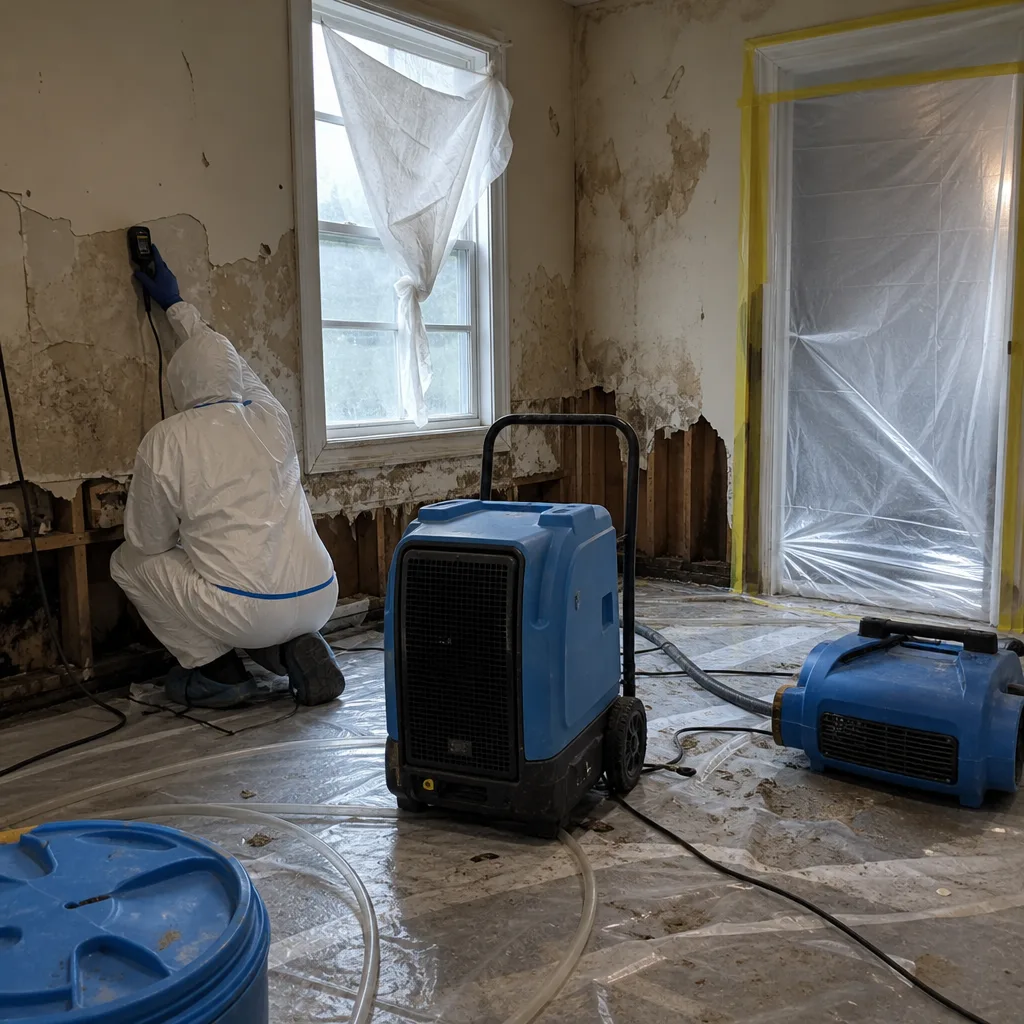 Before
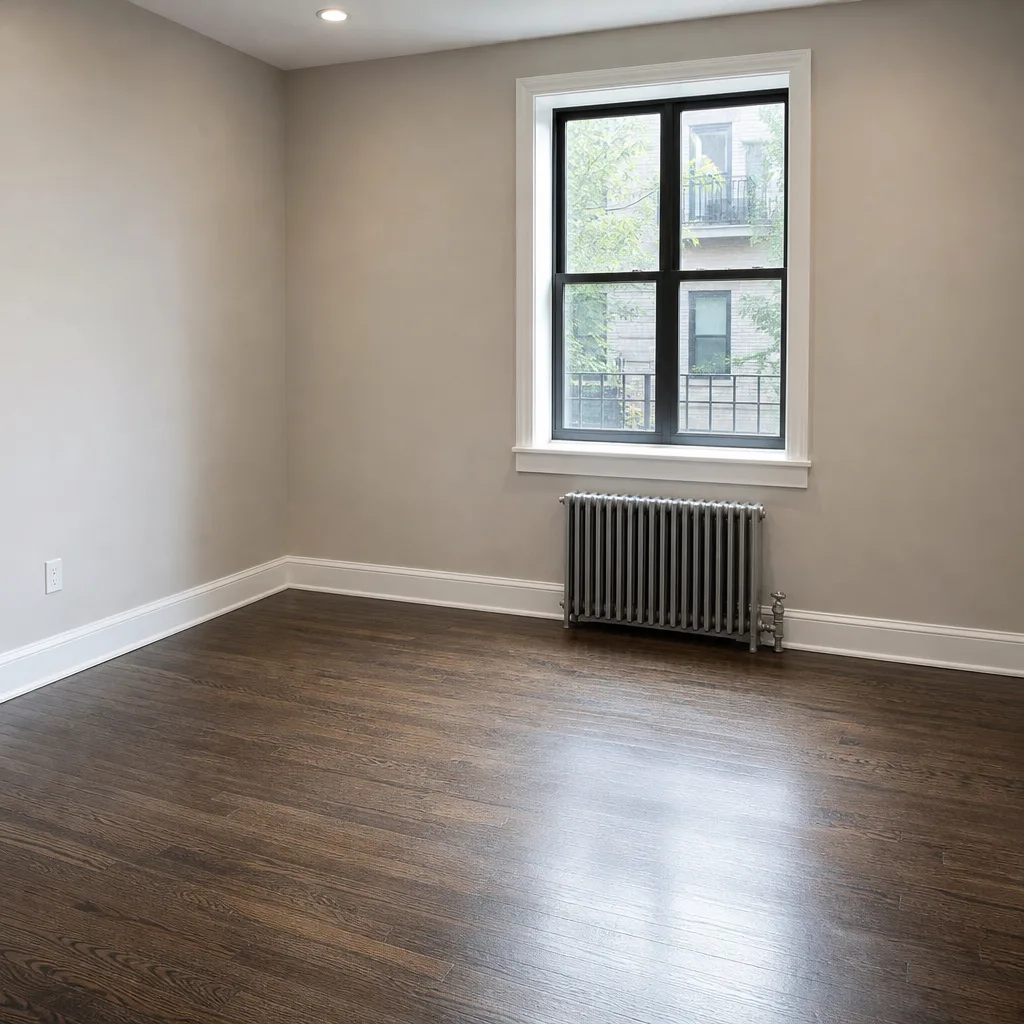 After
After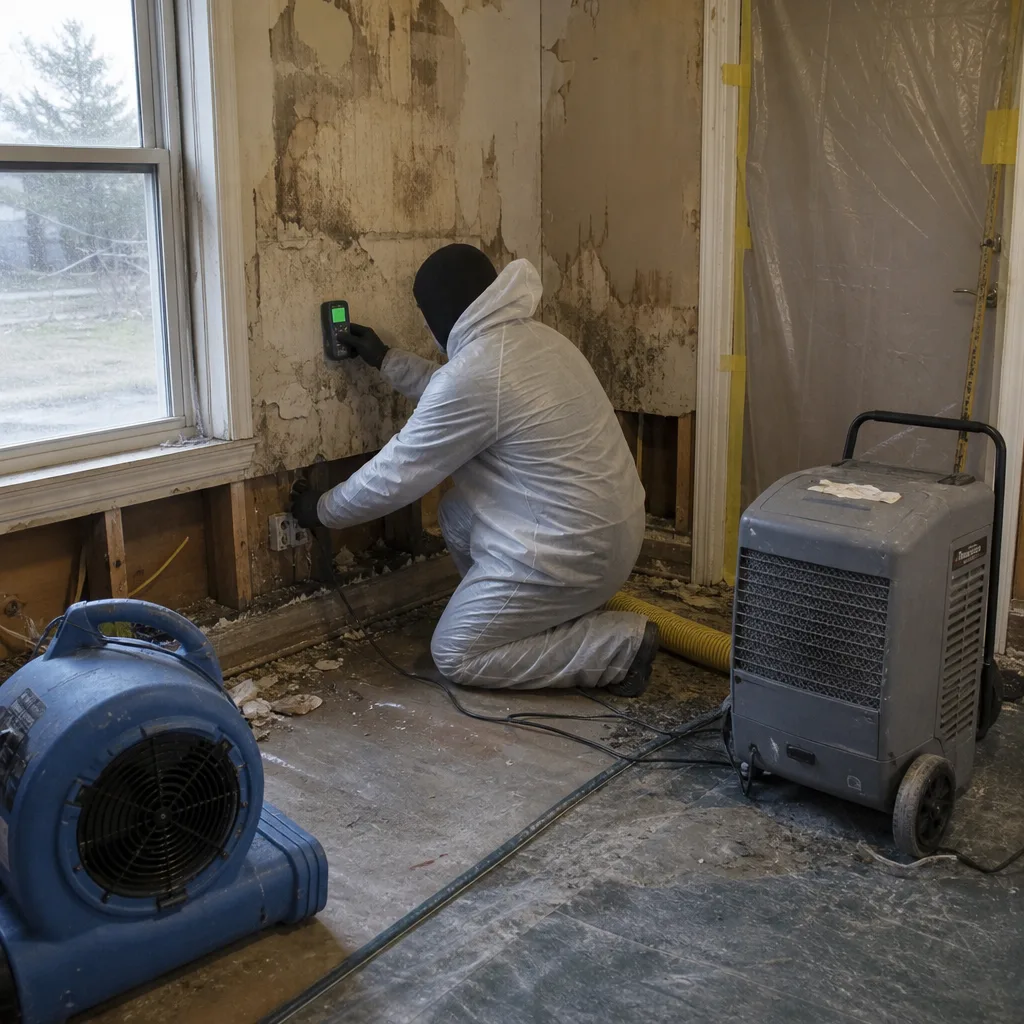 Before
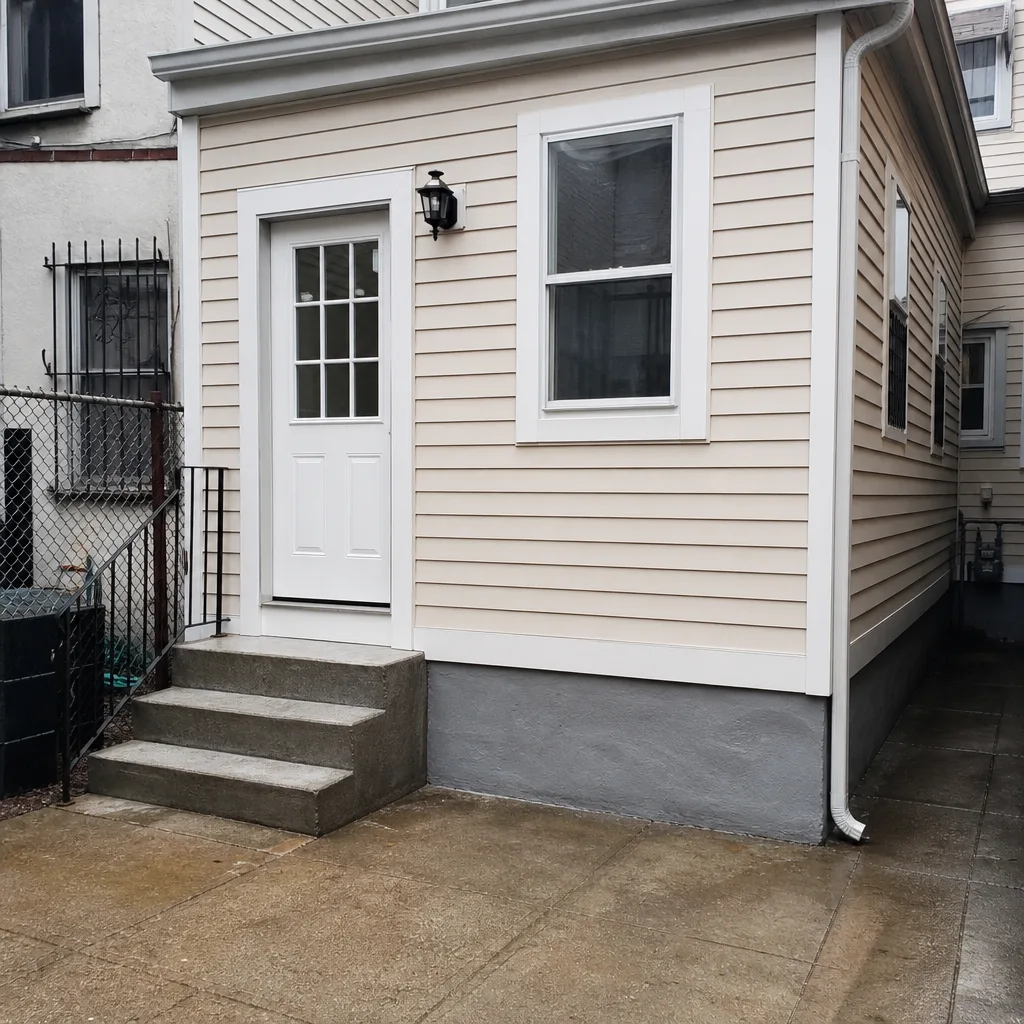 After
After